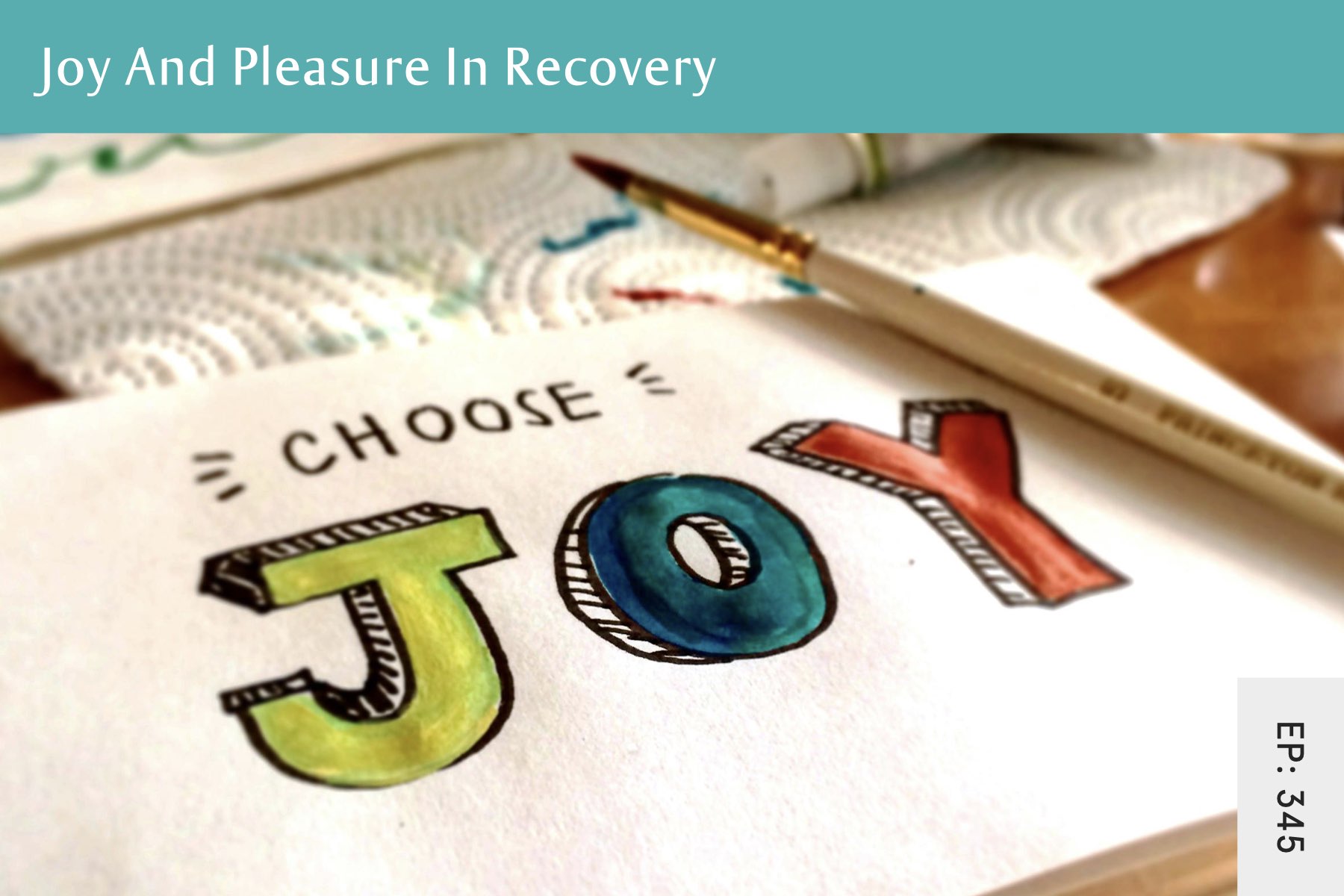
Episode 345: So often when people think of recovery, things like terror, fear and loss come to mind. But joy and pleasure are at the heart of recovery and and rather than being a nice bonus, are actually essential to recovery. In the episode I look at joy and pleasure and how to bring this into your recovery.
00:00:00
00:01:27
00:03:38
00:07:19
00:09:45
00:12:54
00:18:50
00:21:07
00:23:12
00:25:04
00:34:04
00:00:00
Chris Sandel: Hey! If you want access to the transcript and the show notes and the links talked about as part of this episode, you can head to www.seven-health.com/345.
Hey, everyone. Welcome back to another episode of Real Health Radio. I’m your host, Chris Sandel. I’m a nutritionist and a coach and an eating disorder expert, and I help people to fully recover.
Before we get on with today’s show, I just want to say that I’m currently taking on new clients. If you are living with an eating disorder and you want to reach a place of full recovery, then I would love to help. And this doesn’t matter whether you’ve been living with an eating disorder for a matter of months or it’s been going on for multiple decades; I truly believe that everyone can reach a place of full recovery. And I know that that can sound like a pretty big statement, and for you it might be that full recovery feels like this big, distant thing that maybe is for some other people, but I do truly believe that everyone can get there. And it’s not a matter of you may get there; it’s “if you do the things, you will get to a place of full recovery.”
So if this is what you would like help with, I would love to be able to support you on this. Send an email to info@seven-health.com and just put ‘coaching’ in the subject line, and I can then send over the details.
00:01:27
So, on with today’s episode. What I want to do today is I want to look at the idea of pleasure and joy and how important it is for recovery. I know that these are not words that people often think about when they think about recovery; it’s often terror and fear and loss and all of the scary stuff that comes up. But I really think that pleasure and joy is not just this extra thing that you might want to throw into your recovery or might help in recovery; it’s really important as part of recovery.
This was a topic that we covered recently on – I’ve got a group programme as part of the work that I do, so when I work with clients, there’s one-on-one stuff, there’s a programme, and then there’s also a group component. And for one of the group coaching calls, this was a topic that we discussed. This was something that someone had suggested, and we had a really great discussion around this.
So what I want to do as part of this episode is just share some of the ideas that came up as part of this, some of the stuff that I shared with people connected to this topic.
I do want to just say that when I think about recovery and why I think this is so important is recovery isn’t just having a better relationship with exercise, isn’t just having a better relationship with food; it’s in a lot of ways reclaiming your life. The eating disorder, especially as it goes on longer and longer, gets its tentacles into everything. And so many aspects of life become affected by the eating disorder.
So it’s not just about food and exercise and body image. It is how you work, how you rest, how you socialise, thoughts around spending money, love, relationships, how you express yourself, creativity. The list is really endless in terms of how the eating disorder impacts life. So when I think about full recovery, it’s how we really look at all of the different areas that the eating disorder has infiltrated. This is what I want to talk about as part of this.
00:03:38
If I’m looking at the link between restriction and pleasure suppression, when you are living with an eating disorder and you’re restricting, it’s not just food and rest that get impacted upon. It totally impacts your mind, your brain, your nervous system, and it puts you into this survival mode. And when you’re in that survival mode, your body is highly attuned for cues of danger. You’re not looking for cues of safety, or if you’re seeing them, you’re just not recognising them in the same way.
And this isn’t an intentional thing; you’re not telling your brain to do this. This is just what happens when you get into that state. Story follows state, and the state that you’re in has an impact on the kinds of things that naturally arise within you, whether that be thoughts or feelings or sensations or memories or beliefs. These things just naturally arise within you.
So when you’re living in this state, restriction, control, self-denial, these become the rules, and it then isn’t just about food. It’s also about joy and fun and intimacy and play and all of these other things.
Really, what the eating disorder does is trains you into finding safety in control, and that control then spreads. So “Don’t rest until you’ve done enough. Don’t say yes unless you’ve earnt it. Don’t let yourself be too happy, because then what’s gonna happen?” What I notice so often is that the eating disorder makes this promise of “Later on, you’re going to be able to enjoy yourself. We’ve got this dinner coming up tonight; let’s exercise now, let’s not eat food now. Then at the dinnertime, when you’re out, you’re going to be able to enjoy it to its absolute fullest. You’ll be able to be so relaxed, you’ll be able to be so calm because you’ve done all these things in advance to allow that to happen.”
And then what happens when you go out to that meal? Invariably what happens is that you don’t actually end up eating any differently than you usually do. At best, you eat the same amount as you usually do at dinnertime. At worst, you eat a lot less. And you’re not actually able to enjoy this thing. It didn’t provide you with this freedom. You’ve been told it’s going to lead to this way of being able to truly enjoy that experience and it just does the opposite.
You don’t then get that real payoff. It’s not like “Oh, I’m so glad that I did all that restriction because I then had such an amazing time at that dinner and I felt so free.” It just means that you had a really not-great day and then you didn’t have a very enjoyable time when you had that dinner out.
When I then think about pleasure and joy and all of this, really, recovery is about, how do we widen your life? And yes, allowing hunger, but how can we also allow laughter and softness and spontaneity and play? A big part of this is how do you then start to shift your nervous system, and how do you start to do things differently that allow you to really experience these things more?
And I’ve seen this happen with many clients in a really short amount of time, where they’re able to recognise, “Hey, people have commented that I’m laughing more. People have commented that I’m more present” and that comes about because yes, there are certain things that people are doing around food and rest that are allowing that to happen, but they’re also putting themselves in certain situations that they weren’t doing previously. They’re allowing themselves to do things that they weren’t allowing themselves before.
00:07:19
There’s also a lot of cultural messaging around joy and pleasure, so for many people they’re taught that pleasure is dangerous. Too much rest equals lazy, too much food equals gluttonous, too much fun equals being irresponsible. There can be this real diet culture mentality around pleasure in that it needs to be balanced out. So yes, if you want to go and eat this food, you need to then balance it out with exercise, and if you’re not, then it’s just indulgence. It’s this idea of we have to do everything in moderation and we need to make sure that we’re balancing out the scales, we’re not going too far in one direction.
There’s also ideas around productivity that are connected to this – the idea that joy or pleasure is something that needs to be earned through achievement. This whole idea of a real delayed gratification, like “Yes, you can have this, but first we need to do this thing and this thing and this thing.” It’s like the marshmallow test that is done on the five- and six-year-olds where they’re taught to hold off from having that first marshmallow because you’re going to get two if you wait long enough. It’s doing this on this grand scale, but where actually, we never eat the two marshmallows in the end.
All this messaging teaches you that joy must be earned through deprivation and achievement. So if this is the messaging and when you’re then in the state of being with an eating disorder and that message becomes so much more salient, and you remember those things so much more, it makes sense that then allowing yourself to eat or to rest or to have something that’s satisfying feels so unsafe.
It can feel like pleasure is a threat, but it really isn’t a threat. In a lot of ways, it’s how your body remembers how to be safe. And it’s not something that needs to be balanced out. It’s not something that we need to “Okay, if I’m going to do this thing, I need to subtract this other thing, or I need to do this other thing first.” It’s something we need to be adding in and it’s something we need to be building on. I want there to be more joy and pleasure and having that happen more and more often, because it’s been absent for so many people for a really long time, and it then has an impact on how someone gets to experience life.
00:09:45
The next piece connected to this is something that I see is really common, which I call the punishment cycle. For example, someone starts to let joy return, but then there is this backlash that happens after that event or during that event.
For example, there can be shame or there can be guilt or there can be self-criticism or there can be this urge to make up for it. For example, you eat some ice cream or a cake or some off-limit food that you’ve told yourself you’re not allowed to eat, so you have that experience of eating it, but then afterwards there’s this feeling of guilt. And then there are these restrictive thoughts that come up, or there could be even restrictive behaviours because you then act on those thoughts.
Or you could have a situation where you’re hanging out with people and you start laughing more freely. You’re much more present, you’re much more open, you’re in that moment and you’re laughing freely, but then afterwards there’s this feeling of “Maybe I was too much. I shouldn’t have let my guard down like that. What was my face doing when I was laughing? What are these people gonna think of me now?”, and then this leads to a lot of withdrawal, it leads to a lot of shutdown. It leads to “I can’t put myself in those situations again. People must be making fun of me now.”
So there’s this pattern where you have this voice that comes up of like “You shouldn’t have done that. We now need to compensate or make amends”, and what this unfortunately then trains you into thinking is that “If I felt like this after that event, if I felt the guilt or the shame or all this self-criticism, then this must be proof that I’ve done something wrong. If this is how I feel, this is evidence that I shouldn’t have done that thing.”
And this isn’t actually correct. What this is evidence of is that you’ve done something that is stretching you and your system to something new. It’s that you’ve moved out of your comfort zone, so it’s very natural to have these kinds of feelings come up because they’re going against the eating disorder. They’re going against what you’ve done for a really long time. So yeah, it makes sense that there’s going to be some guilt or some awkwardness or some unhelpful thoughts that arise afterwards. This isn’t proof that you shouldn’t have done this thing; it’s just proof that you haven’t done it very often.
And actually, the more you start to do it, the more you start to normalise it. Coming back to the cake example, “The first time I ate the cake, then I felt this guilt afterwards. Then I had these restrictive thoughts. I was able to notice these things. I didn’t actually act on them, but that was the pattern.” And then you do it again and again and again, and what you notice is the guilt’s not as intense now as it was before, or it lasts for a lot less time, or “Oh gosh, this time I didn’t even have that feeling of guilt.”
As you continue to do it, that’s what starts to change. This thing that used to create this reaction in you now doesn’t create that reaction in you.
00:12:54
Also, extending on this idea is using joy as a fuel for recovery. I think, as I said at the top, joy can often feel like this sort of add-on, maybe this bonus, “maybe I don’t really need to do it”, but I don’t think about it that way. I think it is one of the tools that actually helps recovery and keeps recovery going.
Because what often happens – and this is particularly the case as the eating disorder goes on longer and longer – is that more and more of life falls by the wayside. “I used to have these hobbies, but I no longer do these hobbies because that involves sitting and I’m just not able to do that” or “I used to see this person, but I don’t see them anymore because I used to have to go out for a meal and I just can’t do that anymore.”
Or you do the eating disorder version of these things, like “Yes, technically I can go out for a meal, but I have to check the menu in advance, I have to order the thing that’s got the lowest calories on there. I’m doing it, but I’m doing this very augmented version of it and this eating disorder appeasement version of it.”
The thing that happens as more and more of life falls by the wayside and everything gets smaller and more reduced is, counterintuitively, the eating disorder becomes more important. Because if everything else has fallen away and I’m dedicating my life to this thing, I’d better realise how important this thing is. So then the thinness or the restriction or the whatever it is becomes really important because “What else have I got?”
This is why it’s then important to be bringing things back into one’s life. It’s important then as a reminder of why you’re doing recovery, but it’s also a reminder of “Why do I want to be doing life? What’s important to me, and what gives me meaning and purpose, but also helps me to have laughter and playfulness and curiosity and all of these other things?”
When we think about it from this lens, joy actually increases resilience. It helps to regulate the nervous system. It helps to provide motivation for life beyond the eating disorder. And there’s some really good research looking at how these positive emotions help to broaden our perspective, they help to build our psychological resiliency and resources and flexibility.
There’s this theory called the broaden-and-build theory, and it’s by a person called Barbara Fredrickson. The idea with it is that the positive emotions do more than just feel good; they actually broaden our moment to moment awareness and help us to build lasting inner resources.
We can think about it this way: when we feel things like love or joy or curiosity, it opens up our mind. If we think about the word ‘curiosity’ and you think of what it means to be curious, it means I’m open to different things, I’m open to exploring different options. It changes the way that we’re starting to think and we’re starting to feel. So when we’re in these states, we become more creative, we become more playful, we become more willing to explore different things, and this leads to more resilience.
What this then does over time is it helps to develop skills. You then start to develop stronger coping strategies because of this. Because there’s been more openness, because there’s been more creativity, I’m able to think about things differently. It helps with social connection, it helps with problem-solving. It has this knock-on effect where it starts to have a really positive impact on all of these other areas of one’s life, and in situations that aren’t exactly the same.
So “I had this struggle here and I was able to navigate it, and then I’ve got this new thing here that’s completely new to me, but I also realise I’ve been able to deal with this other thing that was difficult for me, so I know I’m going to be able to figure out a solution here.”
If we then contrast this with things like fear or anxiety, this very much narrows our focus. It makes our focus very much on survival, as I mentioned earlier. It trains us to be much more on the lookout for cues of danger, and in a lot of ways you then put the blinkers on and you’re just focusing in this very narrow way.
This constrains one’s thinking. It puts someone on the lookout for all of the things that could potentially go wrong as opposed to opening things up and being “Hey, I wonder what would happen here” and bringing that curiosity. So anxiety and fear very much narrow things versus joy and pleasure expand things.
When we think about it this way, allowing joy in isn’t frivolous. It’s not this nice thing, if you could possibly get it, this add-on. It’s actively helping to build emotional strength, to build self-trust, to build the capacity to do recover over the long term.
I definitely think that the difference between someone who fully reaches full recovery and someone who gets stuck – I would say there’s probably a lot of the joy and the creativity and the curiosity and all of those things that are missing, and someone’s still doing recovery in this very narrow, focused way, and it’s not opening things up in the way that it can.
And again, this isn’t just about “life gets better.” It literally rewires one’s brain so that you’re experiencing things differently.
00:18:50
I also think that pleasure and joy and all of this are really important for self-trust. The eating disorder voice says that if you start enjoying things, you’re going to lose control. It’s this idea of “we need to hold on really tightly here, and if we deviate from this, everything is going to spiral.”
And really, the truth is the complete opposite of this. It is the deprivation and the restriction and all of the clinging on to control that actually creates all of the chaos. When you finally stop restricting, things do balance out, and intuition does return.
And look, these things don’t happen immediately. We need to give them time for them to balance out and for intuition to return. And in some ways, I don’t want it to balance out immediately. If we go from restriction to eating as a ‘normal’ eater and eating in a ‘balanced’ way, we’re not going to pay off the energy debt that has accrued over all of this time.
Where someone thinks is the line for being balanced out is going to be impacted upon by where you’ve been currently living. If we’ve been eating in a very restricted way, someone’s ‘balanced’ way could be just adding in a little bit more and that feels like balance. We often have to go to the extreme in the other direction to really figure out, where is the place that makes most sense to live and actually works best for me?
But when you do that, when you allow that creativity and curiosity and openness, you do figure that out. And as I said, we need to give this time for that to happen, but letting yourself enjoy life and allowing joy really is this practice in self-trust. You start to learn, “I can handle good things. They’re not something to be feared. I don’t need to earn rest or joy. I can be safe when there is abundance. I don’t need to be restricting.” And really, that is at the heart of recovery. It’s learning that it’s not about control, it’s about trust, and that trust is so important as part of this.
00:21:07
As I mentioned earlier, when I think about eating disorders and full recovery, we need to think about this really bigger picture, because the eating disorder infiltrates into everything. So then recovery has to do the same.
Food freedom is super important, but it is just one part. There needs to be also time freedom, being able to rest without guilt, being able to do things that feel ‘frivolous’ but is actually how you enjoy spending your time. There can be emotional freedom, letting yourself feel. And that’s letting yourself feel things like pleasure and joy and awe and those wonderful feelings, but also being able to experience grief and sadness and disappointment and being okay with that and knowing that you can be able to handle these emotions too.
Having social freedom, being able to say yes in connection to things that you want to do – being invited out to things, being able to do things that add to the quality of life – but also being able to say no when you mean it, because “Hey, I’m not in people-pleasing mode, and this thing that I’m being asked to do is actually just not what is best for me in this moment” and being able to recognise the difference between those two.
Being able to have creative freedom. Being able to express yourself in lots of different ways, whether this is through work, through hobbies, practices that you enjoy doing, drawing, going and doing an improv group, whatever it is, being able to be creative, but without the perfectionism. Without the fear of “What are people gonna say?” – or having that fear come up and still going and doing it anyway.
So recovery in a lot of ways is about, how do we make your life bigger and bigger, not smaller and ‘safer’? It’s about rebuilding this capacity for a full life, and a full life includes things like joy and pleasure and awe.
00:23:12
I want to then just share a few ways of being able to do this. Some of these can be just how to get started with some of this.
The caveats, or the things I want to mention upfront with this, is I know sometimes the word ‘joy’ or ‘pleasure’ or any of these kinds of words can feel intimidating or too big. Words matter, so what are the words that you can use to describe this that feel more appropriate and don’t make it feel overwhelming?
Find tiny pleasures as well. We don’t have to be finding the biggest, scariest things to start with. I’m all for people making big changes, and with this, it can also be useful to recognise the small things. The warmth of a cup of tea in your hands. Your favourite blanket on your lap. Sitting outside and getting the fresh air. A song that you listen to that particularly moves you in a certain way.
I would also say it’s useful to recognise that joy can often feel muted at first in recovery. As I talked about at the beginning, that’s because of the state that the body is in. Your physiology has a big impact on your capacity to experience things like joy. But like so many things, the more that you repeatedly do them, the more that joy then expands with practice. So there is part of this that’s being driven by the physiology piece, but part of it is there’s this association between joy being seen as a threat, and the more I’m able to do it, joy no longer gets seen as a threat. Joy gets seen as something that is actually joyful.
00:25:04
So here are a few things you can do to start to bring more joy into your life, or to start to notice the joys that are already going on.
Have a practice of naming different sensory moments that bring comfort or warmth to you. It could be the smell of coffee, it could be the feeling of sunlight, it could be a song that makes you exhale or creates shivers. I definitely listen to music and there’s times where things have this really profound effect on me. Maybe you’re not going to experience that to that degree in that moment, but where can you start to notice these things?
Because as I said earlier, we’re so much on the lookout for cues of danger that these things can be happening but I’m just missing them. How can I start to retrain myself to see that pleasure is already happening in lots of ways in my life, but also that it’s safe to have this and that it is available to me in many ordinary moments?
I would also encourage that rather than just waiting for these things to happen, be intentional about making them occur. This can be based on “Oh, I notice that when I take my time and smell the coffee, or when I get outside and take a breath and notice the sunlight, this has this impact on me. Now I need to be intentional about that. Each day, I’m going to do those things and bring that presence there” as well as “When I notice this new thing that occurred, how can I do that more often? And how can I start to look at, what are the things that I used to find joy and pleasure in? How do I bring some of those in?” Or “I know other people find joy and pleasure in this; how can I start to do this?” Even if at first it doesn’t bring you that sensation, “How can I keep going with it and see what I notice over time?”
The next one is called the permission slip. This is writing out a permission slip for yourself, and you can do – the suggestion here is to do three of them. You can do one, you can do five. It doesn’t really matter. There’s no magic number with them. But you start with the prefix of “I’m allowed to…” So “I’m allowed to rest before everything’s finished. I’m allowed to enjoy food without earning it.” Find the things that most resonate for you in terms of “I’m allowed to…” What would feel a little bit like “Ooh, I’m not sure if that’s actually okay”? Right, I’m going to write that as a sentence of “I’m allowed to…”
And then I want you to put that permission slip somewhere that you see often so that you help to counteract that old conditioning, you help to remind yourself of it. It might be that this is on your desk every day so that you’re working and you’re seeing it, or you put it on your bedside table / nightstand, and first thing every morning, this is the thing that you read. Or maybe it’s connected to the food piece, so at every meal and every snack, before I have it, I’m going to pull out this thing and I’m going to read it. Just reminding yourself of this.
And look, in the beginning, it may feel like “I don’t believe this is true. I don’t think this is going to have much of an impact.” Fine. But I suggest, keep doing it. Because so much of what we end up believing is just because we’ve said it to ourselves again and again and again, to the point where it just becomes a fact. We believe this thing to be true.
This is what I’m suggesting here to try and counteract that. “How can I start to repeat something else enough times that I start to see a shift by doing it?”
The next one is called the pause tool. I talked earlier about the punishment cycle. “I do this thing and then I’m hit with this feeling of guilt or the self-criticism or shame” or whatever it may be. What this tool is about is that you do the thing to give you the joy, so you laugh freely, you eat the cake, you go to this thing that you haven’t been to before, and then when the guilt or the self-criticism hits after the joy or the rest or the whatever, I want you to take three deep breaths before reacting.
Just give yourself the time with this, and then say to yourself, “This is the old voice. I can choose differently now.” Or “This is not what we do anymore.” Or some reminder of “Hey, I’m doing something different here. It’s okay for those thoughts or feelings or emotions to arise. It doesn’t mean that what I just did was wrong. I’m allowed to do these things.”
Another thing connected to this that I’ve done with people that can be really effective is say the quiet thing out loud. So if the thought is “I shouldn’t have allowed myself to eat that cake”, say that word out loud, take a really deep breath in and out, say that out loud again, take a deep breath in and out, say that thing out loud again. And really notice what happens when you do that, when you say it out loud three times while taking that deep breath in and out.
What I’ve noticed and what clients have noticed is that by doing this, I start to relate differently to those words. In the same way as journalling can help, “I see it differently now when it’s on paper”, but using this as a practice to be using your breath to support your nervous system and to help regulate yourself and to slow down and take this time before taking any action that the eating disorder is suggesting that you should be taking.
And then the final one is joy rehearsal. This can be useful if joy feels like something that has been very distant. What you can do is imagine one joyful memory. For some people this is easier; for some people they can really remember before the eating disorder started and how life was and what it was like, and “I have all these wonderful joyful memories before then”, and then for other people, that feels really hard. “I feel like this is how I’ve always been. It feels really challenging to do this.”
So as part of this, you don’t have to think about something monumental. It can just be, when was there this joyful moment? And if it’s harder for you to think of one, “When was there a time when someone was really supportive to me?” or whatever it may be.
But finding that joyful moment where you were laughing with a friend or you were having this fun time on a summer day or you were at a musical festival or you were travelling someplace. Recall how that felt in your body. Imagining or remembering that scenario and then recognising, what does that feel like in the body? Where are you noticing those sensations?
What this rehearsal does is helps to reawaken some of those neural pathways. It helps you to remember that experience, and not just remember it cognitively or in theory, but to actually in a sense experience that. This is one of the things that we can do as humans: we can think about something and have a full-body experience like we were experiencing it. You do that every day as part of your eating disorder when you think about all the things that you don’t want to do. Having a particular meal that feels scary. You start to feel those sensations within the body even just thinking about it.
So what I’m asking you to do is the opposite of this, which is to actually think about something that is joyful and a pleasant experience and to remember that and to re-experience that, because often that’s just not happening very much. And you want to be able to have that experience again to wake up those neural pathways.
As I said, this can be something small. And if you’re someone who has lots of these that you can remember and you do have a really joy-filled life prior to the eating disorder, great. Spend more and more of your time remembering this and having those experiences.
00:34:04
The final piece I just want to say connected to this is thinking about joy as an act of resistance. I know for many clients, really getting onboard with the anti-diet idea, with going against diet culture and all of this social conditioning – that can really rile people up in a really positive way, like “Hey, I don’t want to be part of this system anymore. I don’t want to be subjugated to these kinds of things.”
I think we can do the same thing with joy. In a culture that really profits from dissatisfaction and thrives on things like deprivation, so thinness and productivity and self-sacrifice, remembering that joy is an act of rebellion, and every time you rest or you eat freely or you laugh without apologising, you’re saying, “I refuse to live by fear.”
Joy then becomes this form of protest. You’re reclaiming yourself, and in this way, it is not frivolous. It is the opposite of frivolous. It’s this real radical self-care. It’s a declaration of worth. This, I know for many people, can be a way for “Oh okay, this is why I need to let joy in”, because when so much of recovery is like “How do I fight back against these systems?”, joy can then feel like “Well, I don’t really have time for joy. I’m a bit busy for joy. I need to fight against this.”
And I would say, no, joy is your way of fighting back against this. It’s how you then take back your life from the eating disorder and get it to be more expanded.
The final thing I just want to say is recovery isn’t just about food and body image. Yes, those things are important, but really it’s learning to live without the rules that have kept you small and kept your life small, and bringing back in joy and pleasure is the way to do that. Every moment that you have these pleasures is a reminder that safety doesn’t come from control. It comes from being present and being able to actually experience our moment to moment senses and being in that moment.
So I really want to just say, notice today. Notice where there is a spark of joy, and really be with that when it comes up. Because that’s what you’re recovering for. It’s not just the freedom from the pain, but it’s the return of the aliveness and the return of you getting your life back.
So that is it for this week’s episode. As I said at the top, I’m currently taking on new clients. If you’re living with an eating disorder for any length of time, whether it’s a couple of months, multiple decades, I would love to help you to get to a place of full recovery. So if that’s what you’re interested in, send an email to info@seven-health.com and just put ‘coaching’ in the subject line, and then I’ll get the details over to you.
That is it for this week’s episode. I’ll be back next week with another one. Until then, take care of yourself, and I will see you soon.
Thanks so much for joining this week. Have some feedback you’d like to share? Leave a note in the comment section below!
If you enjoyed this episode, please share it using the social media buttons you see on this page.
Also, please leave an honest review for The Real Health Radio Podcast on Apple Podcasts! Ratings and reviews are extremely helpful and greatly appreciated! They do matter in the rankings of the show, and we read each and every one of them.



Policies
Social
Copyright © 2009 – 2025
seven-health.com · All Rights Reserved.
Share
Facebook
Twitter