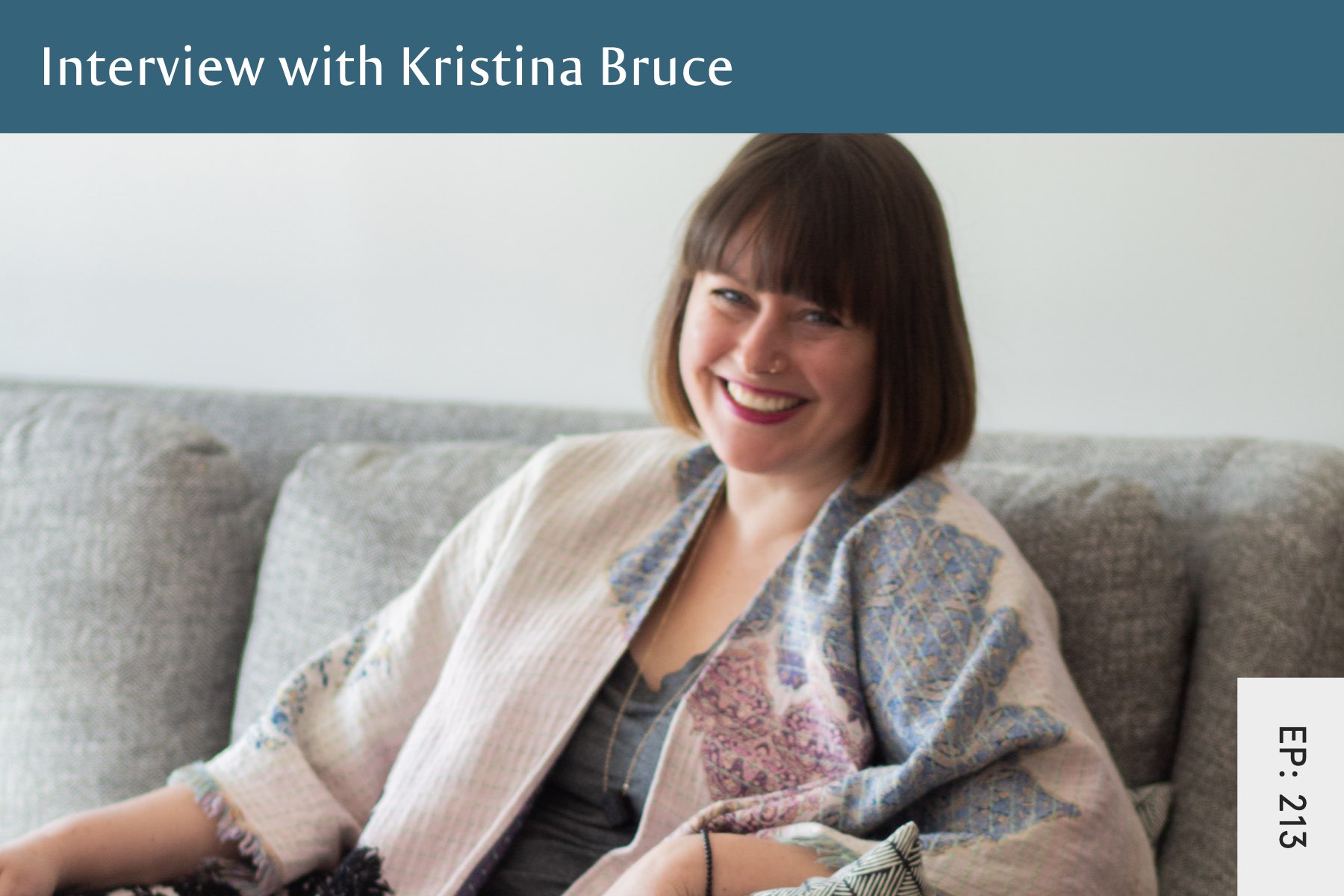
Episode 213: This week on the show Chris chats with Kristina Bruce, a Certified Body Trust Provider and Integrative Life Coach. They chat about body acceptance, Byron Katie's The Work, Kristina's personal journey with disordered eating recovery and acceptance of her body, ayahuasca and more. This is a particularly practical episode with lots to take away.
As a Certified Body Trust Provider and Integrative Life Coach, Kristina specializes in helping people break free from diet cycling and negative body image. Calling upon her education in health studies, sociology, yoga, meditation and self-enquiry methodologies, Kristina works one on one with people to help them develop a positive relationship with themselves so they can live empowering and fulfilled lives, in the bodies that they have.
00:00:00
00:06:05
00:11:22
00:21:09
00:28:13
00:34:59
00:40:46
00:46:25
01:03:45
01:10:07
01:18:10
01:28:52
01:39:29
00:00:00
Chris Sandel: Welcome to Episode 213 of Real Health Radio. You can find the show notes and the links talked about as part of this episode at seven-health.com/213.
For the last handful of weeks, I’ve been starting the show talking about the fact that Seven Health is taking on new clients. At the time of recording this intro, we have just four spots left.
Client work is the core of the business, the core of Seven Health, and it’s the thing I actually enjoy the most. After working with clients for more than a decade, I feel confident in saying I’m very good at what I do. When I reflect on the clients that have sought out Seven Health over the last couple of years, there’s a handful of areas that come up most.
One of the biggest is helping women get their periods back, so recovery from hypothalamic amenorrhea, or HA. I’ve had clients regain their periods after them being absent for 10 or even 20 years, often being told that it was never going to happen again, or clients becoming pregnant who’d almost given up hope of it happening.
I also work with clients along the disordered eating or eating disorder spectrum. Many clients use the term ‘quasi-recovery’ to describe where they’re at because things have got better than where they were at their worst, but they’re still a far way off being at the place of freedom that they want to get to.
At Seven Health, we believe in full recovery. I’ve had many clients who’ve had multiple stays at inpatient facilities where nothing worked, but through working together, they got to a place of full recovery.
Transitioning out of dieting is another big one. Clients have had years or decades of dieting and they know that it just doesn’t work, but they’re struggling to figure out how to eat or how to live without dieting.
Body shame and hatred and just a struggle with body acceptance is the final common area that clients are dealing with. They want to get past this and be able to be present in their life and stop putting things on hold, but they’re just unsure of how to make a start.
In all of these scenarios, we use the core components of Seven Health, which is science and compassion. We focus on both physiology and psychology, so understanding how the body works and how to best support it, but also understanding the mental and emotional side and uncovering someone’s identity and values and priorities and traits and beliefs and how these things can either be helping or hindering the change.
It’s these kinds of clients that make up the bulk of the practice, and I’m very good at guiding and supporting people through this process.
If any of these scenarios sound like you and you’d like help, then please get in contact. You can head over to seven-health.com/help, and you can read about how we work with clients and apply for a free initial chat. This is the last time I’ll be starting with clients in 2020, and as I said at the start, there are just four spots left. So if you’re wanting help, then please reach out. The link, again, is seven-health.com/help, and I’ll also include it in the show notes.
Hey everyone. Welcome back to another episode of Real Health Radio. I’m your host, Chris Sandel. This week on the show, I am back with another guest interview, and my guest today is Kristina Bruce.
As a Certified Body Trust Provider and integrative life coach, Kristina specialises in helping people break free from dieting cycling and negative body image. Calling upon her education in health studies, sociology, yoga, meditation, and self-inquiry methodologies, Kristina works one-on-one with people to help them develop a positive relationship with themselves so they can live empowering, fulfilled lives in the bodies that they have.
I’m a big fan of Kristina’s Instagram. I think she’s putting out a ton of great content and has a really great message. She also works in the area of body acceptance. Considering that this is a big part of nearly every client’s journey, I wanted to have her on the show so that we could discuss it.
I actually outline with Kristina what we were going to cover as part of the intro with her, so I wont’ repeat it here; all I’ll say in addition to what I mention in that is that I found this a really practical episode. When we were going through the different trainings that Kristina has done, like The Work by Byron Katie or the Life Coaching Training with the Ford Institute, we go through examples of practices she’s learnt and how she applies this with clients.
I’m hoping that there are things that you can apply and walk away with just from listening to this episode. This is actually true for myself. What she outlined with The Work is definitely something I will be using, both with myself when issues come up that need examining as well as with clients.
We also talk about Kristina’s recent experience with ayahuasca. If you are a regular listener, you know I’ve done some recent episodes looking at the research around psychedelics, Episode 188 with Will Siu and then Episode 198 with Natalie Gukasyan, but in neither of these episodes did we chat about ayahuasca – or we may have, but it was always just in passing. So it was great to hear about Kristina’s experience.
She had a difficult task in terms of describing these experiences, because they are ineffable; there isn’t the vocabulary to be able to describe them properly, or when you do describe them, it sounds strange and it doesn’t have the same impact as it does, clearly for her, through going through those experiences. But despite this, you can clearly get a sense of how powerful the experience was for her and the takeaways that she got from it.
There’s so much more that we cover, but let’s just get on with the show. Here is my interview with Kristina Bruce.
Hey, Kristina. Thanks for joining me on the show today.
Kristina Bruce: Thanks so much for having me, Chris.
00:06:05
Chris Sandel: You work as a body acceptance coach, and I want to make body acceptance a big part of our conversation today. I was also doing a lot of prep for this interview, and it was really interesting to see the many different trainings that you’ve done, so I thought it would be good to go through these. We can talk about what you got out of them personally, but also how you use them with clients. I’m also a really big fan of your Instagram feed. I think you’re doing an awesome job there. There’s lots of quotes in there that I’m going to try to bring into the conversation. That’s the overview of what I’m hoping we’re going to achieve today.
To start with, do you want to give listeners a bit of background on yourself – who you are and what you do?
Kristina Bruce: Yeah. I was kind of telling you before we started recording that what brought me to doing this work as a body acceptance coach was my own personal experience with disordered eating. I would say that at the worst of it, it was a borderline of an eating disorder. But my background – would you like me to go into a little bit of a personal story?
Chris Sandel: You can go into a personal story for sure. Yeah, talk about how food was growing up for you.
Kristina Bruce: I can say that what was really apparent to me when I was growing up was a very strong sense of praise and admiration for thin bodies. That was really apparent in my family. I come from a long line of, you could say, “hearty stock.” We’re in bigger bodies, and particularly the women in my family were always really concerned about weight loss. Everybody was on a diet. There was a lot of praise for people in thinner bodies.
I picked up pretty quickly that I wasn’t in a thinner body, and it would be a good thing if I was. At least, that was how I could foresee – I equated that with that’s how I was going to get the acceptance and approval and the love that I was craving. I would get that from my family if I could just be thin.
Chris Sandel: How young are we talking? When did you first start to realise this message?
Kristina Bruce: I want to say around eight, nine, ten, that early age. Then growing up, I was actually really active. I was in dance – which shockingly did not end up impacting my body image negatively. I don’t know how I managed to get through 7 years of competitive dance without feeling inadequate with my body, but the thinness factor wasn’t there, thank goodness. It was a really enjoyable experience.
But I was an athlete, I was a competitive softball player, I was a rower. I was always active growing up. I would say it was always in the back of my mind about “thinner is better,” but I think because I was so focused on more what my body could do – I loved being competitive, and it was more about the achievement than it was about how I looked. So I managed to get through high school without really being fixated on that.
But then I went off to university, and again, I was still very active in university. I loved fitness. I was still playing softball in university. But it was after university, when I was on my own and off into the world – I’d stopped playing softball, and this is where I was sitting with this insecurity. Now it was like I was just sitting with myself, and “How am I going to create this life for myself?”
That was when I decided, “I’m going to really focus on losing weight.” That was just the thing now. So I did, and because that was the first time that I’d ever really fully intentionally dieted, it was easy for the weight to come off. When it did, the compliments that I got from people happened immediately. It was shocking in a way. It felt really good in a way, but then in another way underlying it was this real sadness, because I thought, “Jeez, I really am getting treated better, or at least complimented more, for being smaller.” It made me feel really sad.
So it was this weird still wanting to be – and then it instilled a fear in me because I felt really insecure. I wasn’t secure in who I was, so I was seeking this outward approval. Getting it through my body felt great, but then it was also this fear of losing it. So I went through a lot of years like that.
00:11:22
But then I was always interested in – I started into this journey of spirituality and inner exploration. That really started with yoga, so I got involved in yoga and then I became a yoga teacher. I got into this whole wellness world with yoga, and of course, in the wellness world, eating is crazy. As you know. [laughs]
Chris Sandel: Yeah.
Kristina Bruce: It becomes really attached to this identity of being a ‘healthy’ person and being a yoga instructor. So I dove into that and got even more into my disordered eating through ‘wellness’. There’s the irony. It got to a point where I got more and more rigid about it and more and more concerned about my weight loss, but at the same time I was doing a lot of inner exploration. I was getting a lot more in touch with myself, and I started to do this work where I was questioning a lot of these beliefs that I’d come to believe about how I’m supposed to be and the way the world works.
I actually really got into – there’s a method of self-inquiry called The Work of Byron Katie. I attended her 9-day School for The Work a couple of times, and that was really a game-changer for me. It completely opened up my mind and my world, and it opened me up to a lot of self-compassion ad self-acceptance.
So there were these two paths diverging. On the one hand, I’m starting to become really awakened to my inner worth and value just for being me, and that it didn’t require me to look a certain way, and at the same time I was still really into this disordered eating and fear of weight gain. This was still running the show.
I ended up meeting my now-husband, who was my boyfriend at the time – he moved in with me, and I started to notice how I couldn’t uphold anymore my rigorous eating patterns and exercise regime if I actually wanted to have a relationship, if I actually wanted to spend physical time with him. But it also showed me how unstable my emotions were because I was just hungry all the time, and I was so, so fixated on so much fear around this weight gain.
It really got to this breaking point. I’m looking at it now, and it was this convergence of paths where I knew deep down, “This is not healthy for me anymore. My worth is not my weight,” but yet this pattern was so strong in me that I needed something strong to break it.
I ended up, after going through a lot of emotional upheaval with realising I just couldn’t keep this up anymore and I didn’t want to keep it up anymore – I just stopped. One day I was like, “That’s it. I’m done. I’m done with this dieting.” And mind you, I’d say about a year up to this, I had started to hear about Intuitive Eating, I’d started to come across Health at Every Size, so the seeds were planted.
It was in this year as well that I was doing life coaching training, so everything happened at once. I stopped dieting and went through my own recovery process. It’s interesting; I really liken stopping even just dieting as recovery because it’s almost like this addiction. There’s so much emotional release that you go through.
As I went through this, and then I was done with my coaching training, I said, “This is what I want to coach people on,” because I had gone through it myself. I had had the experience, and I just saw, oh my gosh, our world is so steeped in this idea.
I’ve always been so curious, with my background being in sociology and seeing patriarchy and racism and all these influences of what leads us all to come into our conditioning of what we see as a good body and how we end up absorbing that to equate our worth – I was like, “This is the work I want to be doing. I want to be working with people to dismantle their identity and how that’s attached to their body and what they make their body mean about themselves. Actually, their true essence and self-worth that resides underneath that is there regardless of what our body looks like.
Chris Sandel: Nice. There’s a lot there I want to go back through. One of the things you said was you started down this spiritual path, and it sounded like yoga was the first as part of that, but then it went on. What was the pull with that? Was there a “If I go down this spiritual path, then I’ll be able to live permanently in a thinner body”? Was that the initial pull, or was there something else?
Kristina Bruce: No, the initial pull was honestly like, “I just want to feel good in myself. I feel a lot of insecurity. I don’t feel stable in who I am.” This yoga felt like it was reaching a part of me that was yearning to be seen and be explored, which I guess would be my spiritual self or our truer self. It was this aspect that I’d never – it wasn’t the mind, it wasn’t education, it wasn’t thinking. It wasn’t the body, it wasn’t physical. It was beyond that. It felt like it was this portal into this body of work I could explore that I’d never explored before and was touching a part of me that, up until that point in my life, I had been lacking.
I’d grown up religious – not hardcore religious, I guess you could say, but I was religious. But even that didn’t land with me. This felt like it was reaching this part of me that was yearning for this exploration. That was the drive for yoga, and I actually started with kundalini yoga, which is not even really so much about the body. It’s really more about energy in the body and connecting more with yourself.
But then through that, I got more exposed to your standard forms of yoga in the Western world, which would be like hatha yoga, and I liked how I felt. My body felt good doing that, so that’s what I got a teacher training in.
But it was through becoming more involved in the yoga world that I would start to see other bodies, other ‘yoga’ bodies that were thin, and this idea of the clean eating and the healthiness. I felt more inadequate in my body when I would see that so many other people were thinner than I was. That almost contributed to it. So on the one hand, I was opening up this deeper portal into self-acceptance and this deeper connection beyond the mind, but then I was also still fixated on this identity of being a yoga teacher and what that meant and what that looked like. That hit up my insecurities as well. I was like, “Well, I guess I would be better, I’ll be more accepted if I’m thinner.” It almost fed into it, in a way.
Chris Sandel: It sounds like that came along afterwards, not to start with.
Kristina Bruce: That’s right.
Chris Sandel: It’s interesting hearing your story there, because I finished school, did a business degree, finished that after 3 years, had no idea what I wanted to do, moved from Sydney over to the UK, and then age 21, 22, was starting to try and figure out who I was. I’d had a lot of insecurities and worries as a teenager. I was always really small, so I had a lot of issues around feeling not masculine and just trying to understand myself.
I did a lot of reading and exploration – I struggle with the word ‘spirituality’ because I don’t think that sums up what I was looking for, but it was much more about understanding the human mind or the human condition or what it means to be happy or where thoughts come from, all of those things that are so impactful on how we experience the world.
So yeah, I can relate in some ways in terms of a lot of my twenties was doing a lot of that kind of work. It’s interesting now seeing through friends that there’s a lot of people who didn’t do that in their twenties who are now in their late thirties, early forties who are starting that journey because they’ve reached this point where they’re looking around and thinking, “Is this what I want my life to be like?”
Kristina Bruce: Yeah, like, “Is this it?” [laughs]
00:21:09
Chris Sandel: Yeah. You said also that you didn’t really start dieting until this one time at university. What about in your teenage years, or what about with friends? Was dieting a thing with the people you were hanging out with?
Kristina Bruce: It really wasn’t, actually, growing up in high school. I did have one friend – we both rowed together, and I do remember both of us did occasionally talk about losing weight, but I was never really that interested in or that committed to it because we were also training partners, so we would be running a lot.
But for me, really, it was so I don’t feel like I’m going to die at the end of a race. [laughs] Those rowing races are so taxing on the system. So we might chat about it occasionally, but I never really went that full on into it because for me, it was like, “I want to be strong in order to be a successful rower.” The athleticism actually kept me more focused on feeling good in my body, feeling strong, being fit, versus it being about my body size.
It’s interesting because looking back, I remember I would wear these body-hugging singlets, and I never felt insecure. I was thinking, my goodness, if I was older, I would be feeling so insecure about it. But I never did. I never felt like somehow my body was too big or wrong. I do remember looking at some of the other girls and being like, “Oh, they’re smaller than me. It’d be nice if I was a little smaller,” but that would be the extent of it. I never really went too much into pursuing it because, again, I was still focused on being a strong rower. I wanted to win races. That’s what I cared about.
Chris Sandel: I would imagine at the point when you did start your recovery journey, knowing that you’d had that body and you’d worn those outfits and you’d been okay with it at some point in the past, it was potentially something you could reflect on and be like, “How was I able to do that before?” I would imagine that was quite helpful.
Kristina Bruce: Yeah, it’s so funny; I never really thought of it until talking about it now. [laughs] I didn’t think about that. It was such a distant memory at that point when I was in the middle of my recovery work.
What actually did help me was – and this is a little bit later – when I started my recovery work, I was in my forties – not forties. I’m not 40 yet. [laughs] I’m almost 40. I was in my early to mid thirties. That chapter of my life, I think, was closed and I wasn’t even thinking of it. But it was when I was in my recovery and I would start to see, thanks to those ‘Facebook memory’ posts that pop up, I would see these Facebook memories come up of pictures of me when I was thinner. It would shock me that that’s how thin I was.
I remember the first time I saw it after I was in recovery and I was like, “Oh my God, really? That’s what I looked like?” Because I never felt that that’s what I looked like. I was never thin enough. I never felt like I was actually thin.
It actually was something really helpful that my husband said to me. When I was caught in the midst of really feeling so upset over gaining this weight – basically, when I was in recovery and I’d see pictures of myself gaining weight and I’d feel like, “Oh my goodness, I gained this weight,” and then I’d see pictures of myself when I was thinner and be like, “Oh my God, I can’t believe how thin I was,” he said, “You’re looking at yourself now through the same eyes that you were looking at yourself then. Of course you’re going to see the same thing.”
That is what actually started to transition me to realise it’s not my body. It’s the eyes that I’m looking through. It’s the mind’s lens that I’m looking through that I’m seeing it. If it really was my body, then life should’ve been just peachy keen when I was thin, and I would’ve never felt insecure or never felt like I still needed to lose weight, which was totally not the case. It really didn’t have anything to do with that, but like I said, it’s just funny bringing up this story now and reflecting on it. Yeah, I actually was totally fine.
Which brings me to a lot of times the work that I do with clients – when we’re really focused on things that we enjoy in our life and we’re invested in what we’re doing, the body is neutral. We don’t think about it. That’s the case when I was rowing. I wasn’t thinking about my body. I was invested in what I was doing.
Chris Sandel: Totally. It was the vehicle that allowed you to live an enjoyable life doing things that were fun.
Kristina Bruce: That’s exactly it.
Chris Sandel: You mentioning about the photos, I notice with clients that – and this is on a continuum, so it happens differently – but in the early stages, there’s often looking back on photos and that being a trigger and them being really reminiscent and wanting to get back to that place and feeling like “Oh, why can’t I have that old body?” Then at some point, that changes where there’s either the experience that you talked about like, “Wow, I can’t believe I was that thin,” or they look at it and they used to think they looked amazing and now they look at it and they’re like, “I don’t think I look great in those photos.”
But there’s this added layer on top of it where previously, when they would look at the photos, it’s very one-dimensional, “I just want that body,” with all the other experiences stripped away, whereas when they look at it later on, when they’re further on in recovery, they look at their body and they remember everything that they had to go through as part of that.
So it’s not looking at it through rose-tinted glasses; it’s remembering al the gruelling exercise or the restriction or the fact if they were going to a restaurant, they had to check everything on the menu. It became much more three-dimensional and filled out as opposed to just this image that they wanted to get back to that had been stripped of all its negativity.
Kristina Bruce: That’s right.
00:28:13
Chris Sandel: You also mentioned in terms of meeting your partner – how was that as an experience? In the beginning, were you trying to keep your eating behaviours under wraps so that he didn’t know what your eating looked like? How was it for you in the early days?
Kristina Bruce: He knew what my eating was like, for sure. [laughs] I live in Canada, and he emigrated from Argentina to Canada. When we were initially living together, he couldn’t work because he didn’t have a working visa, so it was sort of nice; I had my own little personal chef at home. [laughs]
What would happen is I would come home from work, because I was working at an office, and if dinner wasn’t ready immediately, all hell would break loose because that’s when I was so underfed that I was just starving. Also, I would be making these comments like, “What’s the portion you’re giving me?” I was so particular. I was very open with him about my eating.
What was really great and what I think really helped me in this relationship was he was totally the opposite. He is an intuitive eater, always has been. He couldn’t be more uninterested in food if he tried. He likes it, he eats what he likes, he eats when he’s hungry, that’s about it. He has no fixation on his body. He was just totally the opposite. Thankfully, he was like that, because I didn’t then have somebody to collude with in that, but I got to see this opposite. I would be shocked when he’d leave food on his plate because I was always so hungry I had to eat everything. It was like, wow, you can actually be like this? People are like this? [laughs]
Again, I grew up in a dieting family. My family is still dieting to this day. Eating patterns around dieting was what was modelled to me. So to see this – and for him, he saw the stress that I was under. He saw that it was really rigid. But he was very open, and he was with me the whole way. He literally was with me through the whole recovery process. He was with me through all of my weight gain and was thankfully – I feel very lucky to be with somebody who was super supportive and was open to – I would be like, “This is HAES and this is Intuitive Eating. I need to tell you all about it,” and he was on board and supportive with it.
So it was nice to have somebody who could model for me what relaxed eating and body image looked like.
Chris Sandel: Nice. Were there fears from your end like “If I change this and I gain weight, he’s going to leave me”? Or you always felt comfortable in the relationship that that wasn’t the thing that was going to happen?
Kristina Bruce: I think I was so in my – yeah, that was a part of it, and I expressed that. I would express that to him, and actually, I wrote a blog post where I interviewed him on his experience with me. He did say – I’ll be really open and honest about this – he said, “There was one moment where I had this feeling like ‘Oh, she’s gaining weight. I don’t know how I feel about that.’” But because he’s also a very aware person, he goes, “I knew that that was just my own conditioning. I knew that was the culture coming into me, and within 5 minutes it was gone.”
Here’s the other thing, too; we actually met at the School for The Work with Byron Katie, so we both had this base commitment to self-inquiry and questioning beliefs that we had learned, so we had this baseline where he could be very open. If he was thinking something that was really stressful or judgmental, he could question it, just like I would do the same thing.
I think that helped him, but also, I didn’t feel scared because I’d been so open with him throughout the whole process. I talked to him about everything. [laughs] I think that helped. I didn’t hide anything. We’re very, very open with each other, and that I think really helped along the process. He knew at all the given times what I was going through, what I was thinking, and I would just express to him what I was feeling and what I was afraid of. Thankfully he was very supportive.
Chris Sandel: Were there moments of thinking “This would be a lot easier if I was single”? Part of the reason I’m asking this is when I’m working with someone who’s in a relationship, a lot of the time that’s the thing they’ll say, like, “This would be so much easier if I was single and I could do this and sort this out and then meet someone.” And then I hear the opposite from people who are single and like, “It would be so much easier to be in a relationship and do this.” I hear both sides, but I just want to hear from your perspective, were there parts where you were like, “This would’ve been easier if I wasn’t in this relationship”?
Kristina Bruce: No. Not for me. Here’s the other thing, too. I’ve been single for a lot of my life. I’ve been in some relationships, a few long-term relationships. I was 34 when I met him, so I have a lot of experience of being alone and being single. Obviously, I married him; it was the first relationship that really worked for me. It felt like it was right. It felt like it was the right time, and I felt really grateful to be with him.
But I think it all depends on who you’re with, what the circumstances are, what your own past experience is. I think it’s really different for everyone. For me, it just happened to be that it was the right situation for me to do this work.
00:34:59
Chris Sandel: You mentioned about a degree in health studies and sociology. What was your earlier career, or what were you doing with the degree and Master’s at the time?
Kristina Bruce: It’s interesting. Life takes twists and turns. I actually would say I’m using the degrees now in this work more than I was before. I went off after university and went into event planning. So I didn’t actually use it.
But it had always been such an interest to me, and I guess that’s also what was part of my interest in yoga and the wellness world. I was always interested in health and wellbeing, and also just looking at our culture and the way that our society shapes and influences us – different structures in our culture. I was always really interested in that, and it came full circle in doing this work now, where I’m like, “Oh, this is great. I’m actually in my degree now.” [laughs]
So I wasn’t really using it, but what was so great about health studies particularly – it was actually coupled with sociology – is it looked at the social determinants of health, and it had us question, when we were learning, what our current medical model is like and the biomedical model and how it looks at the body as this series of parts without really looking at it holistically, without looking at the different factors that affect our wellness.
That really opened my mind up and opened this world to me that previously I hadn’t been aware of. It was like, oh, so we are greater than this, and our environment influences us and our relationships influence us and our work or our income level, all of these different factors influence our health and wellbeing, if not more so. It’s not that we have a faulty body or something’s wrong with our body; we’re intertwined with our whole culture and our whole society, and that absolutely shapes and impacts us and our wellbeing.
That made me open to it. I remember in university, it opened me up to alternative medicine that previously, coming out of high school, I hadn’t heard of. Back in I guess the late ’90s, that was still – it’s a lot more popular now than it was back then. So it opened me up to this whole world. I’d come up with my ideal world of what the medical system would look like. I would call Western medicine as we know it “heroic medicine.” I was like, a naturopath is not going to help you if your arm falls off or something like that. There are so many great heroic interventions that Western medicine is necessary for and that we need for and that is life-saving.
Applying this to preventative medicine, overall wellbeing, isn’t working. Popping pills – I remember I went to the doctor once and I had acid reflux, and it was like, “Here’s a prescription.” I was like, “No, if all it is, is acid reflux, I’m not going to take a prescription for this.” That’s all they could offer me. I thought, there’s this whole other world and all of these other healing modalities that would be so much more beneficial for something like acid reflux than a prescription.
My studies and that really opened me up to that it’s not just one or the other, that we really could come into harmony with all of these different wisdom traditions, and these different ways of healing could be combined. It really then takes in the psychospiritual, emotional aspects of ourselves. That really influenced and gave me this base foundation for understanding how we’re affected when it comes to body and weight and the health side. I do not buy into the fact that our weight is the cause of all of these ailments, and my work with health studies and sociology set up the foundation for that.
Chris Sandel: I think that works at both the macro and micro levels. Macro, understanding health at the population level and that it’s not just a matter of people need to eat better food and people need to do more exercise. There are so many factors that come into this, and it’s a topic I’ve discussed on the podcast on numerous occasions.
But then even at the individual level, it can help you to understand, there are so many factors that I need to be thinking about that can be at play in terms of – as you talked about, relationships and income and all these things. Not all of them are going to be in your control, but I think so much of the focus these days is on this real narrow band of if you eat better and move your body better, then that is going to deliver health – and normally ‘health’. Actually, there’s so much more to it than that.
Kristina Bruce: Absolutely, 100%.
00:40:46
Chris Sandel: The yoga training you did – did you think you were going to become a yoga teacher? Was that the original goal? Or it was more doing this training for you as a practice that can then be helpful more in your personal life?
Kristina Bruce: Yeah, that’s right. It started out just for personal exploration and really about how this could benefit me. Like I said, I felt like there was this piece missing in my life. There was an area that was open, that was looking for some exploration. For me, I call that my spiritual part, or really I just call it connection to the self. That to me is what I define spirituality as. It’s my relationship with myself.
That’s where yoga came in, and I was also I think looking more for some healing from traumas that we all experience growing up and almost as a bit of – I went to therapy, too, around this time, so I was opening up to this world of healing, and I felt like yoga was a pathway to that.
It wasn’t until maybe a good 5 years of practicing, if not more, before I decided that I wanted to do the teacher training. And even the teacher training, I was scared to do it. [laughs] I was like, “I don’t know if I can teach this.” It was an opportunity to learn more and dive in more for myself, and then I thought, “Well, if I end up liking it, I can teach it after. If not, it was just another intensive of yoga training.” But then I ended up teaching it afterwards.
Chris Sandel: Is that something you use with clients these days?
Kristina Bruce: I don’t use yoga practice so much in the sense of like “Do these asanas” or anything like that. It’s not prescriptive. But certainly the yoga and meditative aspect of yoga is a part of my sessions. When I work with clients, in the beginning of our consultation I’ll ask them if they have any experience with yoga or meditation because I do bring a meditative element into our sessions.
I begin every session with a centering exercise, and there’ll be times maybe throughout our sessions where we’ll be like, “Okay, let’s close the eyes and take some deep breaths. Let’s do some sensing into how you’re feeling,” so getting more in touch with the self and really stilling the mind and dropping into the body, connecting with the heart. Those are elements of yoga. So I do bring it in; it’s just not in the sense of the physical postures like we’re taught to see yoga as. But yes, I do bring it into my work with clients.
Chris Sandel: Nice. I use meditation a lot with clients – and not as you’re describing there in the sessions, but having them do it outside of sessions, just as a tool more to really start to explore the mind and the kinds of thoughts that start to occur and as a way of getting people to appreciate how much there is this constant stream of consciousness that is forming of its own accord. Just because you have a thought, doesn’t mean that (A) you believe that thought or (B) that you, the person there, generated it. You are a witness to that thought as opposed to being the one that generated it.
Just starting to really get people to grips with what is going on inside their head, because I think so often you have this very different sense as to how things are prior to doing meditation to how you really start to notice they are afterwards.
Kristina Bruce: Yes, absolutely. That’s the key point: to create – you say the witness – to create that separation between the mind and who it is that’s observing the mind. If you notice a thought, who is it that’s thinking the thought? You can’t be the thought if you actually see it. It’s separate from you.
I love some of my teachers, like Byron Katie and – I listen to a lot of Eckhart Tolle, and they’ll say, “Are you thinking, or is thinking happening to you?” When you wake up in the morning and you have a thought, did you think that thought? Or did that thought just appear?
When we can disconnect the personalisation from the thoughts and realise it’s not us who’s generating these thoughts, that we have this somehow problem where we’re thinking these thoughts all the time – these thoughts are just coming into our awareness, and when we can recognise that and we can see that we’re actually separate from it, then we don’t have to buy into it anymore. We can then create, through that meditation process, like they always say, looking at thoughts like clouds in the sky and letting them pass – it’s developing that practice. Then we don’t take our thoughts so seriously, and then that’s where we actually reduce our suffering.
00:46:25
Chris Sandel: You’ve referenced Byron Katie a umber of times already. I think it’d be great to spend a bit of time chatting about her and The Work, because (A) I’ve never talked about it on the podcast before, and (B) I know of her name more in passing as opposed to having read it or experienced it myself. So I’d love to hear more about it.
Kristina Bruce: Byron Katie, I guess you could say she’s a spiritual teacher. It’s interesting; I came upon her work – she has several books, but her very first book is called Loving What Is. I remember I picked it up in the bookstore one day and started reading it and just couldn’t get into it. I couldn’t even get past the first chapter. So I put it on my bookshelf.
I think it was about 3 years later, I was in this relationship that wasn’t working, and I was feeling quite down about it, and I remember walking over to my bookshelf and I picked up this book again. I’m like, “I’m just going to give this a read.” I started reading it, and this time – it’s cheesy, but it was like this explosion went off in my head, and I was like, “Oh my gosh, whoa, this is amazing!” I devoured the whole book.
Then it was around that time I said, “I’m yearning to go on a retreat. I just want to get away and I want to do some deeper work.” Then that’s when I went to the School for The Work the first time, which is where she does a 9-day intensive using this process that she calls The Work.
Essentially what The Work is, is just a series of questions that you bring to your stressful thinking. You identify a thought that is stressful – and she’s got a whole process for it where you can have these worksheets to write out your thoughts. She has everything on TheWork.com. It’s all laid out. But it’s really this series of four questions. You take a thought and you meditate on it. It’s really a meditation.
The Work works best when you can really have an open mind, when you can be like, “I’m going to really be open here.” It requires a lot of openness and courage sometimes to do this when we’re questioning thoughts that we believe to be fact or truth.
It’s this series of questions. The first question is you take this statement and you ask, “Is it true?” Then you sit there, and it helps to have a situation in mind where you had thought this particular belief or thought.
Chris Sandel: Do you want to go through it? Let’s use an example, just so it becomes a bit more tangible.
Kristina Bruce: Yeah, I was just thinking about that. It’s interesting; I remember actually doing this work with somebody else who also practices The Work, and she had started to be introduced to this idea that “Oh hey, maybe you can just accept your body and you don’t always have to be losing weight.” She had this belief that eating chips is bad. That was her thought. She had this memory of when she was on the phone talking to somebody, and she was eating these chips out of the bag, and she had this thought like, “Oh, eating chips is bad. I shouldn’t be eating these chips.”
So we took this thought – what I did with her is, as a facilitator – and with The Work, you can just trade facilitation, so I was facilitating her. I had her sit there and anchor into this moment. “Can you remember yourself there? See yourself there on the phone, eating the chips, and you have this thought, ‘Eating chips is bad.’” Then I just asked her the first question, which is: “Is it true in that moment, as you’re sitting there, that eating chips is bad?” You just sit there with an open mind and wait for the answer.
The answer to Question 1 is just yes or no. Not “because” or “maybe” or “well, but…” It’s not that. It’s honest answer, yes or no, in that moment, do you believe that eating chips is bad? She was like, “Yes, eating chips is bad.” Then we go back and say, “Okay, again, you’re sitting there, you’re on the phone, you’re eating these chips.” Then the second question is, “Can you absolutely know that it’s true that eating chips is bad?” Then you just wait and you see yes or no again, whatever the answer might be. It could be yes, and if it’s yes, fine. If it’s no, no. You just feel into that, where that yes or no came from.
Then the third question is – again, you always anchor into this moment. It can be really helpful to stay in the situation because it’s more tangible. Then you say, “What happens? How do you react in that moment when you’re on the phone and you’re eating the chips and you have the thought that eating chips is bad?” Now you go back and are almost like an investigator. You’re just looking and witnessing, like “What happens?”
It’s like, “When I have this thought that eating chips is bad and I’m eating it, I notice that right away I have this sensation of ‘ugh’. There’s this pit in my stomach, or I feel a little tense. My body starts to tighten up, and I start to shame myself, and I beat myself up internally.” This could be happening in your mind. “I notice I get down on myself, and then I berate myself for doing it, ‘Oh, look at you, doing this again.’ Then I start to think of the future and I’m like, ‘I’m going to eat more healthy now for the rest of the day. I’m going to put these chips away.’” Or you might have memories of the past where it’s like, “Yeah, I remember when I couldn’t stop eating these chips and I ate all of them, and I’m so bad.”
So you witness how you react and what happens as you’re eating these chips and you have this thought, “Eating chips is bad.” Pretty negative experience. Then you go to Question 4.
Question 4 – again, nothing’s changed; on the phone, eating the chips – and then you ask, “Who would I be in that moment without the thought that eating chips is bad?” Nothing’s changed. You’re still eating the chips, but you don’t have the thought that eating chips is bad. This is the one where it takes a little bit more. You kind of need to go into a little bit of a hypothetical scenario and just sit there and meditate on it, like “Gosh, if I was sitting there eating these chips and I didn’t have that thought, who would I be? What would be happening? How would I be feeling?”
I could even sit down and do this myself. It’s like, well, I notice that without that thought, I feel a lot more open in my body. I’m not so contracted. I feel more relaxed. I feel okay. I notice the chips are pretty tasty. I’m not really worried about anything. I notice that I can keep eating them or I don’t have to eat them. I don’t really feel there’s any rules. I’m talking on the phone, I’m enjoying this conversation, got these little snacks. They’re salty, they’re sweet, whatever it is. That would be my experience.
It’s having this experience of like the only thing that changed in that moment was believing the thought “Eating chips is bad” and then noticing what it’s like without the thought. It starts to now open up some space. Is it really the chips that are bad, or is it what I’m thinking and believing about the chips that’s causing my distress?
Then there’s a second phase to it. The second part is what they call the Turnaround. You take the actual statement, as it is, and you look for an opposite. So it would be like “Eating chips is bad” – you could start by saying, “Eating chips is not bad.” Then, again, meditate on that. Can you find an example of how it could be as true or maybe even truer that eating chips is not bad? You can sit with that.
I could sit here and say, “Eating chips is not bad.” Really, let’s go to an extreme example – I’m not dying. It’s not causing me any serious health issue right now. What’s bad? I don’t know, nothing seriously bad is happening now. So there’s an example that they’re not bad. What could be another example of eating chips is not bad? Well, I’m getting some good. I’m getting some nutrition. There is nutrition. I’m eating. I’m becoming satiated. Okay, so eating chips is not bad.
You just sit there and start to come up with as many examples as you can think of that feel true for you. It’s not about forcing yourself to believe something different; it’s an honest inquiry, and it requires meditating on that moment, just being open. What could be an example?
Chris, you could probably even follow along with this and imagine yourself there eating chips. What’s an example of eating chips is not bad?
Chris Sandel: Even if I back up a sec, part of me when you were going through the fourth one, what would happen if you didn’t have this thought, I imagine there is a percentage of the population that you would do this with where the fear would be, “If I don’t have this thought, then I’m never going to stop eating chips. I need to have this negative thought to put the brakes on me actually eating the chips.” So I’m just wondering if you then take that thought and go back to the start and have that be the original thing.
Kristina Bruce: That’s it. Then you would take that thought and say, “Okay, I need this thought. I’ll never stop eating chips unless I have this thought. Is that true?” That’s exactly it. Then you play around with the different examples. Eating chips is good” could be another turnaround. Like, whoa. I remember when I did this with her, she was like, “Whoa, I don’t know about this. That seems so crazy,” because it was the opposite of the original belief.
But as you go through this process, you start to become a bit more open now. It’s like, okay, eating chips is good. Actually, I get pleasure from them. I’m enjoying this. Then she had this memory of how she used to eat chips with her family and that was a really enjoyable experience, and it was connecting her with her family.
So you go through this process and everything starts to open up, and what we do is find balance. It’s really about coming into this place of balance and neutrality.
This process, again, it’s not about forcing yourself to hang onto this new belief. It’s really about when we look at the parts that are causing us distress, and if this thought of “eating chips is bad” is causing us distress, we’re upset or it causes us stress, then we’re swung all the way to one side of a pendulum. We’re not free. We’re locked in by this idea.
The Work can start to bring us into balance, and it starts to open us up to these different possibilities and give us this different perspective. To me, coming into The Work and using this in my life was a game-changer. It opened me up in all different areas of my life.
I don’t use this necessarily with all clients. Some clients, I’ll use it with and they really resonate with it. Like I said, when I first came across this 3 years prior to finding it, I could not do it. It just was not working with me. But then later it did. Actually, I introduced it to one client who was really struggling with food and her body; she took to it so much, it was like the rest of our sessions were only doing The Work. That’s all she wanted to do, and now she’s fully into it. She’s off doing other courses just on The Work and it’s her whole life now. By the end, she was like, “Honestly, food, it’s not even in my radar anymore.” [laughs] It so transformed her.
Yeah, it can be that powerful. Again, it’s a tool. It’s an option. If it works, it can really work.
Chris Sandel: I think it’s the universality of it. You do that once or twice and then you start to realise, “I can do this in so many areas of my life.” As you say, it’s not about shoehorning in your beliefs; it’s about starting to question the default places that you naturally go, and are those default places correct, and are they really helping you? Then starting to look at, what could be some alternatives here?
I don’t do The Work by Byron Katie in the way that you described it, but so much of what I’m working on with clients, whether that be getting them to do writing exercises and then we chat about it, or just chatting about things in the session, is starting to look at where are their areas of blind spots or cognitive dissonance or “Hang on a second, you said this thing, but then this other thing, you’ve kind of done the opposite,” and really starting to poke and prod at people’s beliefs – not to prove they’re wrong, but more to open them up, as you described, and start to get them questioning things, and questioning from a place of – kind of like the fourth question asks, to get to, “What could I be believing that’s actually going to be more helpful for me?”
Kristina Bruce: Yeah. In my experience, what I’ve noticed is that my suffering comes down to me believing something. It comes down to me being really invested in this belief and thinking that there’s no other way about it. This particular inquiry process – because that’s what you’re doing, inquiry, in just a different way. This particular inquiry process is the one that I use, and it helps to free me, or at least create some wiggle room from something that before was just so fact.
Again, can it really be my body that’s the problem? When I look back – again, using the example of the photos. If it really was my body, if thinness was really the thing that was going to make me happy and give me everything I wanted, then I should’ve been that when I was thin, and I would’ve recognised, and it would’ve solved everything. And it absolutely didn’t. So it’s like, it really wasn’t that. It’s what I’m thinking about it. It’s all of the other thoughts and beliefs, and so much of it is what’s conditioned in us by our culture.
Chris Sandel: Totally. So often with clients, I’m like, “Is this a fact or is this a story?” Just to get them to understand that as much as this feels like it is true or it is just them or this is part of their identity or whatever, it is a story that is being told that is making them feel that way.
01:03:45
Did you do The Work with Byron Katie before or after you trained with the Ford Institute?
Kristina Bruce: It was before. It’s funny because I was really into The Work. It literally changed my life. I always thought it was funny because I never thought I would come across something in my life where I could say that. [laughs] Like when people said, “This changed my life,” I’d be like, “Yeah, okay.” But then I was like, wow, okay, this really did.
It was so impactful that that was the thing that I wanted to do. I wanted to just be a certified facilitator of The Work. But what I realised was it’s so specific and it really doesn’t resonate with everybody. Again, it didn’t resonate with me in the beginning. I wanted another way that I could work with people that was different from that.
That actually is what drew me into getting trained in this life coaching program as an integrative life coach. That’s what drew me to do that program, after The Work.
Chris Sandel: At the point at which you had done The Work and then you were looking at doing this integrative life coaching, did you know at that stage that the work you wanted to be doing with people was around body acceptance and food and that piece that you’d struggled with? Or was it more broadly, “I’m really enjoying this whole self-exploration and spirituality side of things, and I want to help people from whatever angle as part of this”?
Kristina Bruce: It was more I could see how The Work was so powerful for me and helping me to alleviate so much suffering in my life. It’s like with everybody. When they find something that works, you just want to share it with the world.
At that point, though, I was still in my disordered eating. When I started to work with the Ford Institute, I would say it was maybe 3 months into it when I started to slowly question, “Can I stop dieting?” I would say it was about halfway through the program. That was when I committed to stop dieting. So I was still going through my training as I started this process.
It just so happened that as I was going through my own process and going through my own recovery, I had finished the life coach training, and then I was like, “This is what I want to be doing.” It became really clear to me. So it just happened at the right time, because I didn’t go into the coaching training knowing that there was anything specific I wanted to work with people on, but it just so happened that my own personal experience drew me there.
Although I say that I didn’t really struggle with my body throughout my life in the sense of actively dieting, it was always there. It was always there in the background that “Being thin is important. I want to be thin one day.” It felt like, “This is the culmination of my struggle with this. Now I get to do the work to unravel it all and do the healing work around it.” So it all culminated at the end of my coach training and my own recovery.
Chris Sandel: Was it useful to be going through the coach training that year as part of your recovery because you could then implement what you were learning?
Kristina Bruce: Yeah, it was helpful. Actually, I remember it was my first foray into being an advocate. One of the things that I really became aware of once I started doing my own recovery was not only do you become aware of where you see diet culture and fatphobia in everything, I saw it really in my coach training. They would use examples of – if you were to have a goal, if a client wanted a goal, they would say, “Their goal is to lose weight.” I’d be like, “Ugh.”
I remember writing this really long email to essentially the leader of this coaching program – I was still in the program, but I was going through my own recovery at the time – telling her all about my own recovery, my own history, and the impact of using weight loss as a goal and how it’s unsustainable. I really went through this whole thing. I gave her links to Health at Every Size and all this kind of stuff.
She actually came up to me – we were at an in-person intensive, and she pulled me aside and said – because she never replied back to the email, so I was like, “Oh gosh, I wonder how she felt about that.” But she pulled me aside and said it was so impactful to her that she really had been sitting with it. She then told about her history of dieting and the history of how much pressure she had from her mother to be thin. So it brought up her own stuff, too, around it.
I think she stopped using it so much as an example. I remember I didn’t hear her use it as her go-to example. My hope was that it made a bit of a change. So it gave me the little – I was scared, but I was like, “All right, here’s my first opportunity to try to advocate for this.” And I was using the tools that I was learning, so I was giving myself the courage to do it and that kind of thing.
Chris Sandel: A good lesson in boundary-setting.
Kristina Bruce: Yeah.
01:10:07
Chris Sandel: I know we just went through an example with Byron Katie’s The Work. Is there anything that sticks out from this training where you are like, “I use this thing fairly regularly with clients”?
Kristina Bruce: The piece I think from that particular training that really stood out for me was really accepting all of the parts of yourself.
When we make ourselves wrong – if we can’t sit with the idea that – a big one for people is “I’m lazy.” If we reject the idea of being lazy, if we think that it’s so bad and wrong, then we’re always going to be in conflict. We can never truly be ourselves. There’s another piece where we’re always going to be working against ourselves if we can’t embrace and accept what we might call the dark aspects of our humanity, the parts we like to keep in the shadows, we like to keep under wraps – the negative qualities that we don’t like about ourselves or that we’re told are wrong.
Can we actually sit with them and start to see how they could actually be serving us in some way, and how if we don’t make them wrong, can we just see that they’re part of the spectrum of humanity? If we’re always telling ourselves that we have to be good and we have to only be these good qualities, then we’re always going to be struggling if we come up against the part of ourselves where we’re angry or we end up being rude. We might not like being rude, and it might not be the quality that we necessarily want to go to all the time, but if we can accept that “Sometimes I can be rude,” can we look at what can be the gift in that?
It’s like, sometimes maybe being rude to somebody who’s really not getting that I’ve set a boundary or I’ve expressed that this is not okay, and the only way they’re going to listen to me is if I might be rude – that could be the gift in that.
So the piece of really accepting the parts of ourselves that we have always been told are wrong or shameful is the integrative part. Then we can actually have some peace around all of our humanity. That’s a practice. That’s a work whenever it comes up. But that part I found to be quite impactful. I didn’t have to make myself wrong so often. Could I actually sit and make peace with those parts that I have always been told are wrong or shameful?
Chris Sandel: I think it also speaks to the power of language, because even when you use the word ‘lazy’ there, that comes with a whole load of connotations or with baggage, where you could actually describe the exact same thing using a different word that doesn’t have that same set of baggage attached to it. Nothing’s necessarily changed in terms of what someone’s doing, but they relate to it very differently.
I’ve got an exercise I do with clients, and this is specifically around body image, but looking at themselves in a mirror – it’s a whole mirror exercise – looking at themselves in a mirror and describing each part of their body as if they were describing it to someone who is blind, is unable to see them, but using only neutral descriptors. So getting used to using language in a way that then starts to change the way you think about things.
Kristina Bruce: And even with the word ‘lazy’, which is quite loaded, especially in our culture – our culture hates laziness. We really look down upon it. One of the challenges was always, what could be a gift of being lazy? If I look at it, it’s like, I give myself some time to rest. I can actually just sit with being with myself. If we can look for the good qualities or the gifts of it, it can take some of the sting out of it as well and reframe how we relate to the word.
Chris Sandel: Totally. Again, you have someone who’s sleeping 9 hours a night who thinks “I’m being really lazy,” and you have a second person who thinks, “I’m sleeping 9 hours a night because I really prioritise good amounts of sleep.” Just reframing how you think about it. Sometimes you’re going to be able to only move it from being negative to neutral, and then other times you’re going to be able to see it very clearly as a strength. That sounds really helpful as a tool.
I was looking up the Ford Institute as part of doing the prep for this, and I know that they do a lot of talk around shadow work. It seems that was what you were alluding to. Is that a big part of the training, or at least the training that you did?
Kristina Bruce: Yeah, it was a big part of the training. I have to say, I wouldn’t say it’s the piece that informs a lot of the work that I’m doing right now. What they offer, when you come out as a coach from the Ford Institute, they do have a coaching protocol that you can follow, but you have the choice not to follow that. I chose not to follow that because I felt it was a little bit – it wouldn’t allow me to use other tools, like The Work and other practices. It was very prescriptive.
So I chose not to follow their particular protocol, but instead, the value that I got from that training was essentially the coaching skills work out of it. That’s what I use from it.
The shadow work piece of it is part of the acceptance work. It’s the opposite of resistance. That would be the piece that I got from it, but what I really got more from it was the coaching skills training.
Chris Sandel: Then you finished that up and set up as a coach fairly shortly afterwards?
Kristina Bruce: Yeah, not right away. I would say – gosh, my timeline is fuzzy now, but maybe a good 6 months afterwards. Slowly worked into setting up my coaching practice. For me, I wanted to also give myself some more time in my own recovery to get to a point where I felt stable enough and to the point where I could actually be working with others. I’m always big on not pushing myself past my own evolution, so I don’t want to be out there working with people if I don’t feel like I have a good foundation in myself. So I gave myself a little bit more time with that, and then I slowly started to work on opening up my coaching practice.
Chris Sandel: When did it then become really focused on body acceptance?
Kristina Bruce: It was right away. When I took that time, I knew at that point that that’s what I wanted to open up my coaching practice around. I knew, “This is what I’m working with people on.” So right from the beginning, I opened up with that focus.
01:18:10
Chris Sandel: If we’re speaking more from the experience you’ve had with clients, what are the bigger struggles or roadblocks for people in terms of the body acceptance work?
Kristina Bruce: A lot of it is fear of weight gain. A lot of it is this idea that they’ve absorbed that their value and their worth are attached to their size. A lot of it has come from family history, growing up dieting. Either it was having maybe parents who valued thinness – that’s a common thread. It’s really about, “Who am I, and can I actually feel okay about myself if I’m in a bigger body?”
A lot of the work that I do with people, then, is this uncoupling of our worth and our value and really anchoring into who we are aside from our body. Finding and really connecting with ourselves, because when we’re so fixated on our body and dieting, we’re really disassociated from ourselves. So really anchoring into our worth and our value.
Again, through these meditative practices, a lot of the work that I do is connecting with the heart, which I call the area where our inner wisdom comes from, our own inner guidance, what is true for us, to really connect with that and start to see and actually have an experience from within where we hear ourselves saying to ourselves from this place, “I am okay. I am enough. I am loved. I am worthy regardless of my size.” Then it’s working with the beliefs that we’re not enough based on our size.
Also, starting to do a bit of that grief work, because there’s a grieving of the idea of this life, of this thin body, and everything that society praises. It’s really about moving away from seeking the external validation and approval and turning inwards to start to know that the value and approval is already there within ourselves.
Really deep down within ourselves, we know that we’re okay. We know that we’re good enough. It’s just that we’ve had so many years of conditioning that our body equals our worth. Everything that we’ve been told that it means, all of the stigma that’s been associated with bigger bodies, we start to uncouple that and question it, and then find that value within ourselves. Come home to ourselves. This is the place that we can always go to, to find our value and worth and our acceptance.
Chris Sandel: That’s, again, so much of what I’m focusing on as well. Often when having conversations with clients, there’s this part where they realise so much of life is performative, and it’s about what other people are thinking or are going to think or may be thinking about them, and it’s like their life is on a stage and they’re being viewed by others. That just completely disconnects them from what they actually want to be doing.
So a lot of the focus is on understanding, “What’s true, intrinsic motivation and what’s this extrinsic motivation?” and knowing the difference between those two. Because it’s hard – and when I say hard, it’s basically impossible to get to a place of feeling enough and nourished and all of those things when that is hopefully coming from an external source. Unless that is coming from within, there is no amount of validation from others that is ever going to fill that cup.
Kristina Bruce: That’s right. We spend our lives chasing that until the day we die if we don’t instead turn it around and do that inner work. Actually, it got me thinking of – you were asking what else I got from that coaching training that I use. There is a piece that I use.
In the very first session I work with clients, I actually guide them through a life visioning exercise to just begin. I say, “This first session, we’re not even going to talk about the body. We’re not even going to talk about food. We’re going to use this instead for you to get connected with what it is that’s important to you in your life. What matters to you? What does your life look like when you actually are really thinking what matters to you and you’re envisioning this?” Nobody has ever, when they’ve done this visioning exercise, ever been like “Having a certain body is in this visioning exercise.”
It never shows up because it’s never about that. Because when we diet and everything, we’re so fixated on it, it takes over our whole life and it colours everything in our life, and so much physical time, mental space, etc. So using this life visioning process is this foundation.
I remember I had one client who was in recovery from an eating disorder who said, “It was so great to be able to actually see what is possible for my life, what my life can look like without the eating disorder.” That I think is such an important phase because it’s the key to start to get back to you. What matters to you? Not “What have you been taught that you think should matter from society?”
Chris Sandel: You can start there, and then there’s this feeling of – let’s say someone values relationships, and they’re thinking, “But if I’m not thin, then I’m not going to be able to be in a relationship or people aren’t going to like me as much.” Then you can start to pick apart all of those other things we talked about earlier using those methods, but still with this overarching value of they feel that relationships are really important in their life, so how do we help them get the most out of that?
Kristina Bruce: That’s exactly it.
Chris Sandel: You mentioned there about the grieving process as well. I think the whole grieving of the thin ideal is also a really big part of the process.
Kristina Bruce: It’s a huge part of the process. I can tell when a client hasn’t quite reached that phase – and not everybody necessarily goes through a whole grieving process as intensely. I can talk about my own experience. It actually surprised me when I went through this grieving process. It was such a visceral experience.
I can remember this point – I don’t know what it was, but it was almost where I crossed this line into really letting go of dieting, and I cried and cried and cried. It felt like somebody died. It felt like a parent passed. It was so deep, and just the deepest of sobs. It was this real releasing of this identity, this piece of me that had been holding up thinness as the ideal – and also knowing that I was going to have to let go of that external validation.
As I gained weight, the external validation that I used to get stopped. I don’t get those comments anymore. So it was letting go of that, and then feeling afraid of “Oh God, what do I do now? I know this is the internal process.” But that was the part that really started the deeper journey. And I always knew – it was almost like the spiritual path, the journey, this is what it was all coming to. It’s all coming to asking me to go within and accept me. To give me my own validation and approval. That’s my practice and path now.
Chris Sandel: I think it’s also useful to validate, as you said there, you did get more compliments when you were thinner, and that can be the case with people. So it’s not telling them that that’s not true. It’s like, “Yes, and…” What did you have to go through to have that occur, and how did that add or detract from your life? Again, getting back to the openness exercise of like, “Okay, these are the options you have to live your life. Let’s explore how each of them stack up and what are the pros and cons with all of these.”
Kristina Bruce: Yeah. I personally don’t think it does a service to try to pretend that the environment that we’re living in isn’t hostile towards bigger bodies. I think we need to acknowledge that and realise, yes, this is the culture that we’re living in. Is it nice right now? Nope, it’s not. Could it be better? Yeah, that’s what we’re working on.
In the meantime, it still really comes back to that validation from ourselves. Whether it’s about body – this could be in any area of our life. People might be using career as a way to get that external validation, and they’re always going to be searching. Or they could be using money to get the external validation, and they’re always going to be feeling that they need to make money.
Really, the root is coming down to ourselves, and at the same time, the culture changes the more we change and we actually unplug from this paradigm and we start to create something new.
01:28:52
Chris Sandel: I know before we started recording, we were having a bit of a chat and you talked about going and doing ayahuasca. I’m wondering if you can talk a little about that, but also how this then fitted in for you in terms of the acceptance piece.
Kristina Bruce: I actually did it early this year, in February, right before COVID hit. So I was able to get in a trip, luckily. [laughs] At the end of last year I was really overworked. I didn’t know – I guess sometimes when you get so focused on everything you’re doing in life, it slowly creeps up on you, and then before you know it, you’re bogged down.
For me, it took feeling incredibly exhausted. I’m like, “I don’t know what’s wrong with me. I have no idea. I’ve never felt this tired before.” For me, whenever I can take some time to – I don’t have any kids right now, so I have a little bit more freedom to be able to take time off and go away. I just knew it’d been a while, and I was like, “I know I need a retreat. I need a personal exploration retreat.”
I was on my computer and kept looking up retreats. I was like, “I could do a yoga retreat or I could do a meditation retreat,” and I was looking and looking and looking. I was like, “It’s got to be somewhere in February because that’s when I can take this time off.” Nothing was resonating. Either I’d find something and the timing didn’t work or whatever, and then I was like, “What about Costa Rica? Costa Rica has all the yoga retreats. I’ll look up retreats in Costa Rice, and what can I find?”
I came across this place called Rhythmia. I was like, “Okay, this looks like a nice retreat.” Then I looked and I saw, “Oh, they do ayahuasca at this place?” I saw that it was the only medically licensed facility in the world right now, where they are legal to do ayahuasca and they have this health clinic there, and it was super safe and rigorous. I’d heard about ayahuasca in passing, maybe – I always say 3 years ago. That seems to be the number. [laughs] I’d heard about it and I was like, “This is interesting. What’s this all about?” I’m like, huh. It planted a seed where I was like, “One day I’d like to try this, but not right now. But one day.”
Then as soon as I saw it, I said, “Yeah, this is what I’m doing. I don’t really know about this. This kind of scares the crap out of me. I’m not somebody who has done a lot of drugs or anything, but I’m going to go. I know this is going to give me an experience that I’ve never had before, and I’m ready for this new experience.”
So I signed up and I went. Of course, I spent the few months ahead of time reading every article and YouTube video that exists. [laughs] Trying to figure out, what did I get myself into?
You actually participate in four different ceremonies, so you do it four times. It was one of the hardest things I’ve ever done. It was very challenging, but it was also incredibly rewarding. There was so much I got out of it, but the two pieces I got out of it – it really is a healing experience. People go there for healing, people who’ve had a lot of trauma in their lives. There’s a lot of people with PTSD, depression, etc. Although I didn’t have trauma with a big ‘T’, I knew there was still some layers in there that I wanted to look at.
So I went through a process during it – again, very personal and meaningful to me – where I was releasing a lot of self-hatred. That’s what I came away with. I was like, “Whoa, this is what I’ve been carrying for so long.” That really opened me up, where I had this experience that deep down, I am perfectly okay. I am loved. I loved myself. I had a real connection with myself, and I really had this release.
And that release has stayed. I don’t feel that same euphoric moment of self-love and self-communion that I experienced while I was in the ceremony, but what I got rid of has not come back. So that was really impactful.
Another piece of it that happened for me right at the end after doing it four times, I was curious about the body acceptance piece of it, because I went in not really thinking I needed to do much work on that. But I thought, “I’m curious if this will somehow show up.” It didn’t show up during the ceremony, but it all made sense to me at the very end.
This might sound a little out there, but I’m going to just say that I had this real – and you know this from when we look at science and quantum physics; everything is energy. Everything down to its tiniest molecule, if you go down, down, down, every single thing in this world is just energy. So I had this understanding of how everything is energy and there’s energy all around us, and what I say was – oh Christ, I’m just going to say it.
I had this experience of like channeling energy. I know that sounds weird. I remember I was talking to the shaman after and I was like, “Listen, I don’t know what happened, but can you just help me make some sense out of this right now? I felt like I was channeling energy.” [laughs] She was like, “Yeah,” she was totally fine with it.
But I had this experience of – what I was doing in this process was I felt like I was grounding energy. In the ceremony there’s a lot of energy going on, and it felt like what I was doing was grounding it. I had this insight where I saw I wouldn’t have been able to ground this energy – firstly, the grounding was important. If there’s going to be a light or release of energy, there has to be a grounding. There’s two ends of the spectrum. So it was important.
And I realised I needed to be in the bigger body that it was in order to ground it. I actually needed that kind of physical weight in my body, and that served it. I needed to be like that. That was important. My body, as it was, was important, and it needed to be that way. It really showed me that every body type serves a purpose. We’re not all supposed to be thin. That’s unbalanced. We need bodies on all parts of the spectrum. Just like there’s an energetic spectrum, there’s a body spectrum, and one is just as valuable as another.
That was an insight that I got at the end of my retreat there. I really felt the importance of it. It wasn’t just like, “Oh yeah, I’m in a bigger body and let me accept it.” It was like, “No, no, no, this is actually integral in this world. Body diversity exists for a reason.” Whether that’s to channel energy, but what I’m saying is that it exists for a reason, and it’s not a mistake. It needs to be there. That was really impactful.
So I got a real visceral sense of self-love and self-acceptance and to see that body diversity, including my own, was absolutely necessary in this world.
Chris Sandel: Wow, that is really cool. Look, I know I’ve asked you to do something that is very difficult in terms of – I’ve read a lot around psychedelics, I’ve had people on the podcast talking about it – to try and describe certain experiences is very challenging because there’s not the language for it. You’re in these weird states where things don’t make sense. It’s the equivalent of trying to describe a dream where things just don’t add up in the way that they normally do in the ‘real world’.
Kristina Bruce: Yeah. I have to say, from my experience, everything made perfect sense to me. For me, it was like I knew – it made sense in that I might not have understood exactly what was happening, but there was always a message or a lesson or something I got from it that made perfect sense to me.
Chris Sandel: Oh, sure. I think my ‘not making sense’ was more when you try and explain it to other people. In the moment, you’re like, “This is complete truth. I understand exactly why this is occurring,” but later on when trying to explain it to the layperson who’s not gone through that experience, that can seem a little weird or like “this doesn’t make sense.” [laughs]
Kristina Bruce: It’s funny; when I came back, I immediately was telling my husband, “You have to go. I need you to do this just so I can talk to you about it.” [laughs] “Just so you have the same experience and you can get a sense of what I’m talking about.”
01:39:29
Chris Sandel: Part of the reason I asked you about this with the topic of body acceptance is I’ve had, in the last 6 months, two past clients who’ve gone and done retreats and both emailed me afterwards, and both of them have received similar messages or had similar experiences where they were like, “You are enough. You are on the right path. Your body is as it should be,” and that was the clear message they got through going through the ceremonies. And for them, how affirming it was and how helpful it was to hear that at the points they were on – yeah, it just made such a difference for them.
Kristina Bruce: Yeah, absolutely. In this world where we so receive the one message that says it’s only about thinness, it can be hard to believe otherwise. It can really be hard to believe otherwise. So having that personal experience where you really see it for yourself can be really affirming.
Chris Sandel: Definitely. I said before at the start that I was going through your Instagram, and there was this great quote from one of your recent posts, which was “If you can only love your body if it looks a certain way, that’s not love. It’s judgment.” Which I absolutely love, but also just ties into that.
Kristina Bruce: Yeah. Again, that’s the beliefs. That’s the thinking. The thinking is judgment. What I’ve always noticed is whenever I’ve sat in inquiry and I’ve sat without the thought – without the thought is acceptance. Without the thought is love. Without the thought is neutrality.
It’s the thinking mind that says whether something is right or wrong, and if we believe it – what I often do, too, with my clients – again, this comes from my own experience with doing The Work – notice: do you contract with that thought, or do you feel expansive? Do you feel tightness or do you feel relief? I always am like, we want to go towards the relief, the expansion.
Usually it’s questioning the thought. It’s looking at the belief and seeing how that contracts us and how that’s not really the truth for us because the truth is more open and expansive and accepting.
Chris Sandel: Totally. We’ve got into the world where there is fake news and everyone has their own ‘alternate truths’, but with so much of the stories we tell ourselves, there is no ultimate truth there. It is just how you perceive it. There are ways to perceive it that make your life very meaningful and enjoyable and add value to it, and there are ways of perceiving it that detract and make your life smaller and more miserable.
If the reality is that there is no ultimate truth and it’s just to do with how you tell a story to yourself, then let’s try and work out ways that you can not just tell a story to yourself, but tell a story to yourself that you genuinely believe.
Kristina Bruce: Yeah. What’s actually true for you? We all are coming from our own perspectives. We can never exactly believe entirely what somebody else believes because we can never have exactly that other person’s experience. We all come with our own perceptions. We’re all facets of a gem, and when we can start to tap into what’s true for us – and not necessarily make somebody else’s perspective wrong, but just understand that they’re coming from their own perspective.
What I would say too is understanding that most people are living completely in their mind, and they’re believing their thoughts. Sometimes I’ll say with diet culture, imagine most people are under a spell right now. They’re under the diet culture spell, and you just happen to have the spell broken. That’s what it is. You’re seeing this now, and people are like, “My friends don’t see it. Nobody else sees it.” I’m like, “Because they’re under the spell. They’re not going to see it yet.”
Again, coming back to our own truth, I like to say too, it’s like we’re unplugging from this paradigm and we’re plugging back into ourselves.
Chris Sandel: Also, once you break the spell, it’s hard to go back. There is a certain ‘ignorance is bliss’, and once you start to really know the truth, it’s then difficult – it’s not impossible, but it’s hard to go back into that place of having the blinders on.
Kristina Bruce: Yeah. I remember when I was early into stopping dieting, I had this experience. I rationalised or bargained with myself. When I got to a point where I was gaining weight and I started to get afraid, I was like, “I’m going to go back to dieting.” For me, my weapon of choice was always calorie counting. So I was like, “But I’m going to just increase the calories. I’m going to give myself more leeway. I’m going to do it, and that way I can control my weight.”
So I did it, and I think I lasted like 3 days. After waking up, I was able to see so clearly. I have this visual of walking back into a cage and shutting the door behind myself. It was like I put myself back in there, and I felt the stress, and I felt the worry, and I saw how it impacted my life. I was like, “All right, none of that.”
You’re not the same person going back. I couldn’t unsee anymore what I saw. I kind of needed that 3 days of a reminder to just say, “Yep, not going to work anymore. Keep going.”
Chris Sandel: Totally. I think that’s often where clients make the biggest breakthroughs, where they have ‘setbacks’ or ‘failures’ or whatever, because you’re then experiencing that failure with the new knowledge of how different life has been, so it hits you differently. You get so much from that. I think those are normally very helpful experiences.
Kristina Bruce: Yeah, absolutely. That’s why I think we shouldn’t put this perfectionist idea of “you only go forward.” Going back is really helpful. I like to think of it as you’re not going in circles; it’s like a spiral. You’re going up a spiral. It seems like you’re going back, but you’re actually moving forward.
Chris Sandel: Agreed. Kristina, this has been an awesome conversation. Where can people be going to find out more about you?
Kristina Bruce: My website is kristinabruce.com, and I’m also on Instagram, as you mentioned, @kristinabruce_coach. I’ve got a Facebook page, a few YouTube videos up, so lots of places that people can find me.
Chris Sandel: Perfect. I will put all of that in the show notes. Thank you so much for coming on. This has been awesome.
Kristina Bruce: It was great to talk to you. Thank you.
Chris Sandel: That’s my conversation with Kristina Bruce. She was incredibly easy to chat with, and I loved the examples that she was able to give and how tangible and practical this episode felt.
As I said at the top of the show, we’re currently taking on new clients. At the time of recording this intro, we have just four spots left. If you’re wanting help in the area of body acceptance, in recovery, breaking free of diets, or any of the areas that we cover as part of this show, then please get in contact by heading over to seven-health.com/help. I will be back next week with another new show. Have a great week, and I’ll catch you then.
Thanks so much for joining this week. Have some feedback you’d like to share? Leave a note in the comment section below!
If you enjoyed this episode, please share it using the social media buttons you see on this page.
Also, please leave an honest review for The Real Health Radio Podcast on Apple Podcasts! Ratings and reviews are extremely helpful and greatly appreciated! They do matter in the rankings of the show, and we read each and every one of them.

Policies
Social
Copyright © 2009 – 2025
seven-health.com · All Rights Reserved.


Share
Facebook
Twitter